

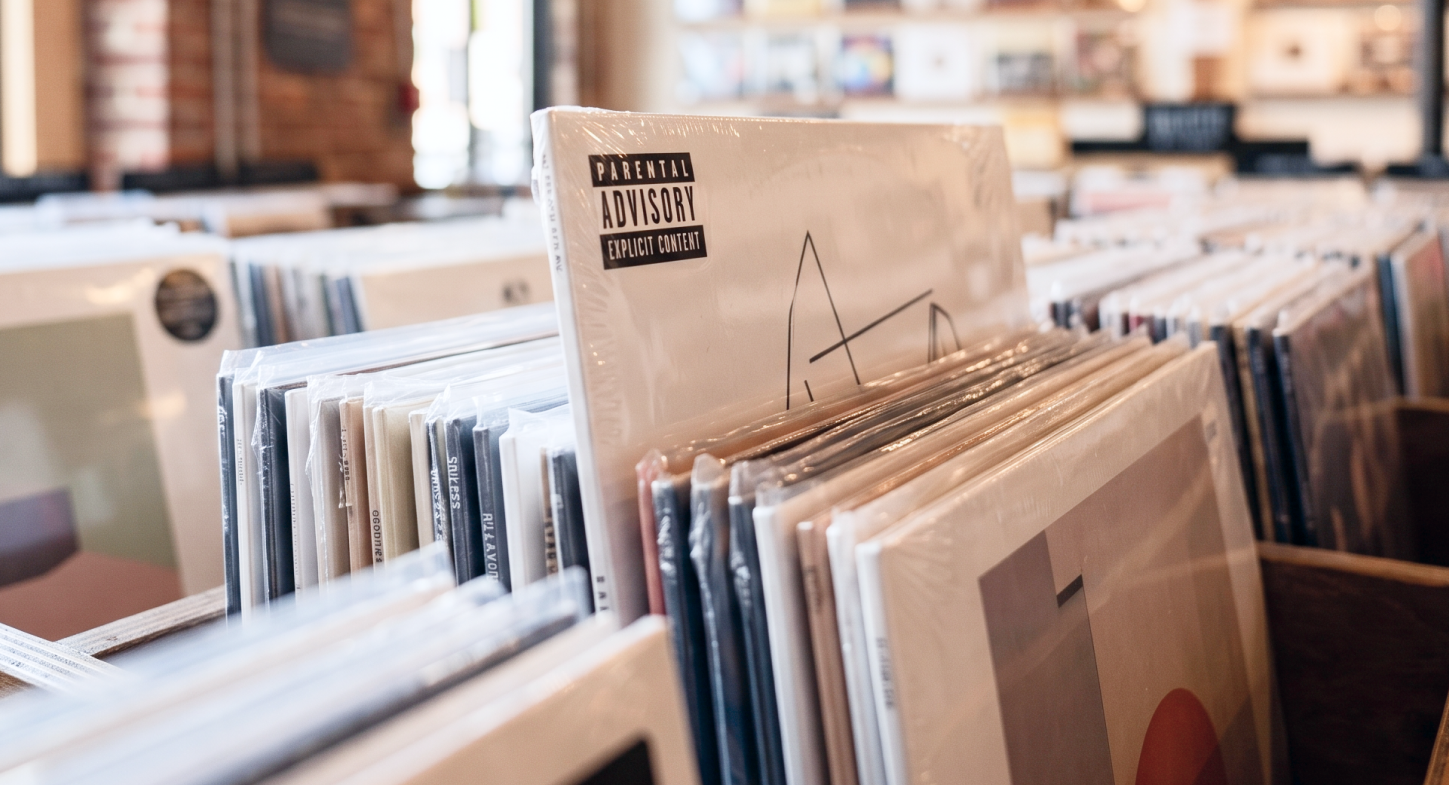
If you're putting music into a family app, a kids' product, or any shared space, you've probably avoided tracks or albums with the “explicit” label, searched for "clean" versions, and assumed that solved it. It mostly doesn't. Music has never had a real standardized content rating system, no scale, no categories, nothing close to what film or video games built. What it has instead is a warning sticker from 1985, and everything downstream of it, including "clean," inherited its blind spots.
What follows is the full history, from the 1985 Senate hearing that created the warning label to what "clean" actually means on your phone today. For how this compares to the film industry, which did build a real system, see why the music rating system never grew past a warning label.
1985: the Senate hearing that tried to give music a rating system
In September 1985, Frank Zappa sat before the Senate Commerce Committee and compared the idea of slapping warning stickers on records to treating dandruff by decapitation. He was there to fight a rating system for music. He won, and the version that survived is the one we still use.
The push came from the Parents Music Resource Center, founded in 1985 by Tipper Gore, Susan Baker, Pam Howar, and Sally Nevius. The group wanted more than a sticker. They proposed a descriptive rating code: a letter to flag violence, one for occult content, one for drugs and alcohol, and one for sexually explicit material, something close to the film model, where the label told you what kind of content a record contained. They backed it with the Filthy Fifteen, a list of songs they considered especially harmful, with Prince's "Darling Nikki" at the top.
At the hearing, Zappa, Dee Snider of Twisted Sister, and John Denver testified against any labeling, arguing that creative expression was at stake and that parents, not the government, should decide what their children heard. The artists who fought labeling helped shape the compromise: something narrow enough to avoid government regulation but visible enough to satisfy the PMRC.
1985-1994: how one warning label replaced a real rating system
The descriptive code never made it. When only a handful of record labels responded to the original proposal, the PMRC scaled back to one generic warning, and the RIAA agreed to apply it at each label's discretion. The Parent Advisory Label (PAL) got standardized in 1990 and revised once more in 1994. Today, it remains a flag with no definitions attached, and no content rating system behind it.
Sources: Newsweek, NPR, RIAA.
The label backfires
Here's the part nobody planned for. The warning label was supposed to steer kids away from explicit albums. It did the opposite. The sticker became a mark of rebellion and authenticity, and kids wanted the albums that carried it. Retailers like Walmart refused to stock labeled albums, which made them harder to get and more desirable. The warning meant to flag content ended up helping sell it.
Where clean music came from
The retailers that didn’t shelf explicit albums created the market for clean music as we know it. When record labels started losing out on distribution at the big chain stores, they knew they needed another way in. So they started producing edited cuts with the flagged content removed or muted, versions retailers would stock and parents would buy, and clean music became the industry's workaround.
That's still what clean music means today: a version of a song edited to remove or reduce content considered inappropriate for a target audience, usually profanity, sexual references, drug references, or graphic violence. It's made by the label or artist, aimed at radio, retail, schools, fitness apps, and other broad-audience settings. And, once again, these edits are managed by the labels and there’s no hard guidelines or policing to ensure clean tracks are actually appropriate for a discerning audience.
The catch: clean music was built to get albums onto shelves. Getting them safely into the hands of kids is a different job.
Why clean music was never a rating system
Clean music has no industry-standard definition. No universal criteria exist, and the RIAA itself notes that an edited version does not necessarily remove all objectionable content. Different labels, retailers, radio stations, and streaming services apply different standards. As Eric "Stens" Stensvaag, Director of Curation at Feed.fm, put it in Feed.fm's Sound of Trust report: "The clean and explicit advisory data record labels supply is voluntary and not closely regulated. Brands can't rely on it to deliver popular clean music or family-friendly content."
Most people assume clean means no profanity, and that no profanity means kid-appropriate. Neither holds. Clean music tells you what got cut from a recording. It tells you nothing about what stayed. A clean track can still carry mature themes, drug references, innuendo, or violence that survived the edit. The term means a distributor's standards were met. Nothing about a content rating system enters into it.
Clean vs. censored vs. explicit
These get used interchangeably, but they aren't the same. Explicit is the original version, containing flagged content like profanity. Clean is a version edited to remove or reduce that content for a broader audience, though it may still contain mature themes that weren't removed. Censored describes the act of removing or obscuring content: a censored version is often a clean version, but the word implies content was deliberately suppressed to meet a rule or standard. A label may release an official clean version, and a radio station may censor it further if it thinks some lyrics still cross a line.
The closest thing to a rating system: radio
Radio is the one corner of music that built working content standards, and it didn't do it with the explicit label. The FCC sorts broadcast content into three categories, obscene, indecent, and profane, and judges it case by case based on context and time of day. The FCC doesn't certify songs as clean or maintain an approved rating system. That responsibility falls to broadcasters.
So most stations skip the guesswork and program the label-provided clean version or radio edit. Many large radio groups also run their own standards departments that review tracks independently, because a song can clear the explicit filter and still raise flags. Radio's standard is reactive, shaped by what labels deliver and what each station decides it can air.
 Today: what this history means for family-facing apps
Four decades after that Senate hearing, the music industry still has no real content rating system. What's left is a binary sticker, inconsistent label metadata, and a patchwork of definitions that change depending on who you ask. Clean music gets you part of the way, but it never answers the question family-facing and brand-safe products actually need answered: is this song appropriate for this specific audience?
That's the gap Feed.fm's music rating system closes, with graduated tiers that go further than a single flag, and lyrical analysis that extends beyond dirty words to identify context and themes that might be considered inappropriate for brands or young audiences. If music is running through a shared or family-facing experience you're responsible for, family-friendly music built around those tiers is the layer worth starting from and the team at Feed.fm can help you navigate this nuanced task.
Let's talk about the right ratings for your audience.

 5 min
5 min